https://www.ahbitt.com/the-ultimate-guide-to-mastering-popular-ball-sports/
In the pursuit of a healthy lifestyle, tennis is a very popular sport. It not only helps to keep the body fit but also improves reaction time and coordination. For beginners, mastering the correct foundational knowledge is crucial. Today, let’s step into the world of tennis and start learning the basic techniques from scratch.
Grip
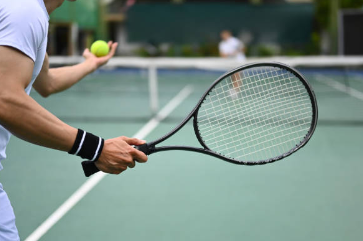
The grip is the first lesson in learning tennis and is also a very important one. The grip forms the foundation for all other movements. Being able to quickly and smoothly switch between different grips when facing various shots can help us better time our hits.
Tennis Racket Structure
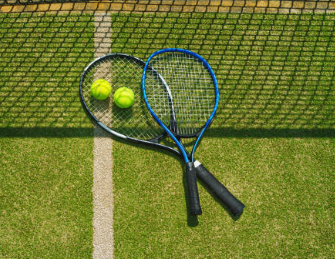
A tennis racket consists of three main parts: the head, the throat, and the handle. The head is where the strings are strung, and it is used to strike the ball. The handle is the part that players hold, while the throat connects and supports the head and handle.
Grip Methods
Palm Grip: This is the most basic grip, suitable for serving and receiving serves. When serving, the player places the ball in one hand’s palm, using the other hand to generate power. The stability of the palm helps ensure stable force when striking the ball.
Forehand Grip: This grip is used for forehand shots. The player places the fingers on the ball’s surface, ensuring the palm faces the ball, providing maximum stability and power when hitting. The forehand grip is useful for making accurate passes and attacking shots.
Backhand Grip: The backhand grip is commonly used for backhand shots or returns. This grip is often applied in situations where hitting a forehand is difficult. It allows the player to control the ball’s direction and speed even when the forehand is not an option.
Pinch Grip: This grip is useful in situations that require quick and precise control, such as intercepting or reacting in sudden situations. By pinching the racket with the thumb and index finger, the player can quickly adjust their hand position and respond rapidly.
Ready Position
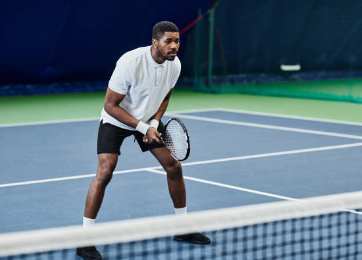
A proper ready position helps players quickly assess the incoming ball and improves the coordination of subsequent movements.
The body should be facing the net, with eyes looking forward.
Feet should be about shoulder-width apart or slightly wider.
The body should lean forward, with knees bent, toes pointing straight ahead, and weight on the front part of the feet. It’s important to note that the body leans forward through bending the legs to lower the center of gravity, not by bending at the waist. The back should remain straight, and the body should form a straight line from shoulders to hips.
The dominant hand should grip the bottom of the racket handle, while the non-dominant hand lightly holds the throat of the racket, positioning the head of the racket at an upward angle in front of the body. For a dominant hand grip, a semi-western forehand grip is commonly used.
Forehand Stroke
Forehand and backhand are the two most frequently used techniques in tennis and require focused learning and extensive practice. Let’s start by learning the forehand stroke.
Preparation
Keep the right foot still and step forward with the left leg to position the body towards the right. The body’s weight should be distributed between the two legs, slightly favoring the left foot, which is aligned with the incoming ball.
With the racket in the right hand, the upper body remains stable while the right shoulder drives the right arm backward. The left arm should extend forward, pointing towards the incoming ball.
Swinging the Racket

The swing is not just about using the hand to hit the ball, but involves a full kinetic chain. Start by rotating the waist, which moves the shoulders, then allow the arms to follow the body’s motion, swinging the racket through to hit the ball. The weight shifts to the left foot. The hitting point should be around waist height and slightly in front of the body, with the racket at a distance where the arm is naturally bent. Keep the racket face slightly angled downward and maintain tension in the wrist.
Follow-Through
The follow-through determines the ball’s spin and trajectory. Beginners usually start with simpler flat shots. In the follow-through, push the racket forward after hitting the ball and rotate the racket around the right shoulder toward the left shoulder, using the left hand to catch the throat or handle of the racket.
This is a brief explanation of the basic movements in tennis. Practicing these fundamentals through repetition will help internalize the skills. I hope this blog helps you better understand the basic techniques of tennis and enables you to take a solid first step on your tennis journey.
https://www.ahbitt.com/the-ultimate-guide-to-mastering-popular-ball-sports/