https://www.ahbitt.com/the-ultimate-guide-to-mastering-popular-ball-sports/
The charm of volleyball largely stems from its rich, diverse, and highly skilled technical movements. Whether it’s a thunderous strike during serving, precise coordination during passing, solid defense during dunking, powerful attack during dunking, or a solid barrier during blocking, each technique contains unique mysteries and challenges. Deeply mastering these techniques not only allows us to perform well on the court, but also enables us to deeply appreciate the essence of volleyball.
Serve: the vanguard horn of the game
Serving, as the opening act of every game, is the first round of attack we launch against our opponents. Handheld serve is like a heavy cannon, testing the strength and skills of players. The server needs to calmly face the net with their left hand and accurately throw the ball to a suitable height above their right shoulder. The grip at this height is crucial, as being too high or too low can affect subsequent power output. Subsequently, the right hand, like a spring poised to take off, swiftly swings its arm from back to front, reaching its maximum height above the right shoulder. The entire palm hits the middle and lower back of the ball with precision like an eagle claw, while the wrist quickly pushes and presses like a nimble whip, giving the ball a strong upward spin. The ball fired in this way, like a chambered shell, with a whistling momentum and elusive rotation, often creates tremendous pressure on the opponent’s field at the beginning of the game.
And the serve is more like a delicate dagger, easy to control, especially suitable for beginners. The server stands with both feet in a forward and backward position, with the left foot in front and the right foot in the back. The knees are slightly bent, and the body is slightly forward leaning, presenting a poised and ready posture. Use your left hand to throw the ball vertically in front of your body for about 30-40 centimeters. This height ensures sufficient time to complete the hitting action and facilitates controlling the trajectory of the ball. Use your right hand with your shoulder as the axis, swing steadily from back to front, and accurately hit the lower back with your tiger mouth or full palm in front of your abdomen, sending the ball out smoothly. Although the power of serving is relatively small, the advantage lies in its high stability, which can accumulate confidence for beginners and gradually start the exploration journey of serving skills.
Passing: The Intelligent Link of Attack

On the stage of volleyball matches, passing is like a conductor in a magnificent symphony, a key link connecting defense and offense, determining the rhythm and tactical layout of the attack. Frontal two handed passing is a classic passing technique and a foundation that players must master proficiently. When the player is ready to receive the ball, their hands naturally open at a distance of about one ball above their forehead, as if weaving an invisible net. Their thumbs form a regular “one” shape with each other, and their wrists slightly tilt back to prepare for the upcoming ball.
Once the ball approaches the forehead, the player is like a precision machine, instantly activating the coordinated operation of the whole body. Through powerful kicking movements, the leg strength is transmitted to the waist, and then with the continuous force of extending the knees and arms, the fingers and wrists are moderately tense at the right time, gently pushing the ball like a lively dancer, smoothly and accurately passing it out. The hitting point of a pass is like a key note in a musical piece, and it must be precisely kept above the forehead so that the ball can fly lightly towards the teammate along the predetermined trajectory as if it has been enchanted, laying a solid foundation for the development of the attack. Accurate passing not only cleverly avoids the opponent’s block, but also creates excellent attacking opportunities for the attacker, which is the core guarantee for the successful implementation of the team’s offensive tactics.
Paddle: a solid defense barrier
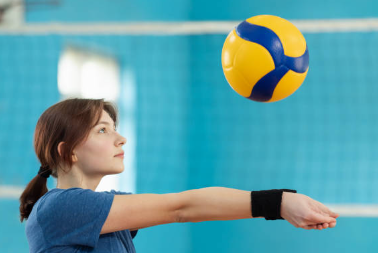
Padball is a sturdy fortress in the volleyball defense system, serving as the first line of defense against the opponent’s fierce attacks. Frontal two handed ball cushioning is the foundation and core of ball cushioning technology. Players should keep their feet apart from each other, with a distance equal to or slightly wider than their shoulders. This stable stance can provide sufficient support area, ensuring the stability of the body when receiving the ball. Bend your knees and lean forward, like a poised cheetah, always ready to face the challenge of the ball.
The palms of both hands are tightly pressed together, the fingers of both hands interweave and overlap with each other, the wrists are pressed down, and both arms are flipped outward, together creating a solid and flat hitting surface. When the opponent’s serve, spike, or catch flies like a shell, the player’s arms need to quickly extend forward and accurately insert under the ball, like building a strong dam in a turbulent river. Subsequently, cleverly utilizing the upward force generated by kicking the ground, the stable support brought by lifting the shoulders, and the rapid movement of lifting the arms, the ball is steadily lifted with the strong rebound force of the ball. The hitting point is usually located at a distance of one arm in front of the abdomen, which ensures sufficient reaction time to adjust the hitting angle and maximizes the coordinated strength of the arm and body. Excellent dribbling skills can turn danger into safety, successfully defend seemingly irreparable balls, and win valuable counterattack opportunities for the team. It is the cornerstone of the team’s defensive system.
Spike: a deadly weapon of attack

The spike is undoubtedly the most dazzling star in volleyball’s offensive end, and it is a heavy weapon used by the team to deliver a fatal blow to the opponent at critical moments. Before launching an attack, the spiker’s run-up is crucial, just like a cheetah’s acceleration sprint before pouncing. Start the run-up at a slower speed, gradually increase the pace, take a small step forward with your left foot to provide initial power for the body’s acceleration, then take a big step with your right foot like an arrow off the string, while swinging your arms back and forth to accumulate strong force for takeoff. Quickly follow and merge with your left foot, use both feet to jump as if about to break through the sky, swing your arms upwards to assist, and make your body reach its highest point in the air.
After jumping, the spiker is like an eagle spreading its wings and soaring, with his chest and abdomen stretched out, his upper body slightly turned to the right, his right arm bent and his elbow pulled back, and his hand placed on the side of his head, as if opening a full bow. At the moment of hitting the ball, the whole body’s strength gathers in the right arm like a surging tide, using the powerful torque of the spinning abdomen to drive the arm to swing. At the highest point, the upper part of the back of the ball is hit with the full palm like a heavy hammer, and the wrist is quickly thrown down like lightning, giving the ball unparalleled speed and strength. The hit ball is like a fired shell, shooting down at the opponent’s field at an extremely fast speed, making the opponent sigh at the ball. A powerful spike not only scores directly, but also greatly boosts the morale of the team, making it a key weapon for the team to defeat the enemy and win the game.
Blockade: The Key Hub of Attack Defense Transition
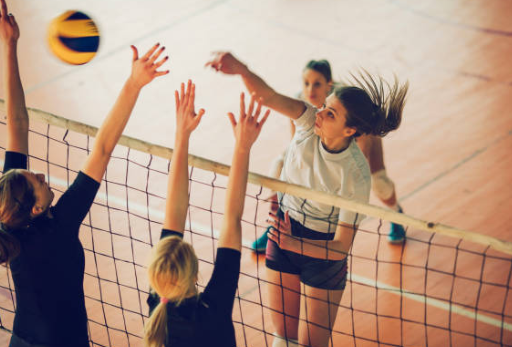
Blockage, as a key node in the transition between defense and offense in volleyball matches, is like a strategic location on the battlefield, and gains and losses often determine the direction of the game. At the critical moment when the opponent launches an attack, the front row players need to act like agile hunters, quickly moving to the front of the net to seize the best blocking position. Jump vigorously with both feet, as if stepping on the sky under your feet. Extend your arms and lift them up as much as possible, naturally opening your fingers and building an indestructible barrier on the ball net.
The core of blocking lies in accurately determining the opponent’s spike route and landing point, which requires players to have keen observation and excellent prediction ability. By instantly analyzing the movements, gaze, and flight trajectory of the opponent’s attacker, players can quickly adjust their body position and arm movements to block the ball’s flight in the best posture. Successful blocking not only directly blocks the opponent’s spike, thwarting their attacking spirit, but also creates favorable conditions for their defense and counterattack, achieving a magnificent transformation from passive defense to active attack. The application of blocking techniques fully embodies the charm of the mutual transformation between defense and offense in volleyball, and is a model of the close combination of individual skills and team collaboration among players.
Every skill in volleyball is like a shining star, shining with a unique radiance in the sky of volleyball. Through continuous learning, practice, and honing, we can gradually master the essence of these techniques, showcase our talents on the volleyball court, and enjoy the endless fun and challenges brought by volleyball.
https://www.ahbitt.com/the-ultimate-guide-to-mastering-popular-ball-sports/