https://www.ahbitt.com/the-comprehensive-evolution-of-ball-sports-origins-diverse-venues-and-modern-facilities/
Ball sports are diverse and rich, each with its own unique charm. As the foundation for the development of ball sports, the specifications and facilities of the courts vary significantly among different ball sports. These differences not only affect the athletes’ performance, but also determine the rules and viewing experience of the competition.
Basketball court
Venue specifications
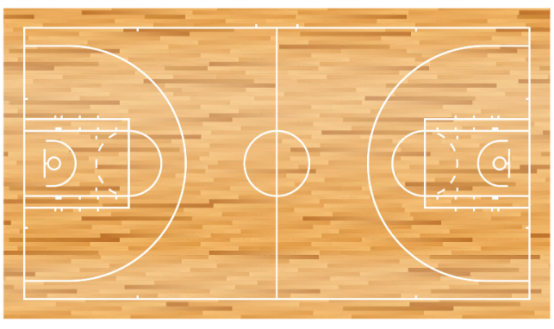
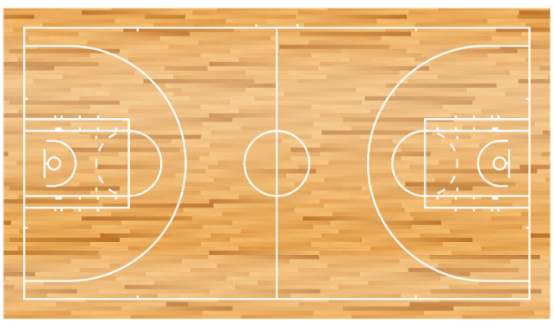
The standard basketball court is a rectangle with a length of 28 meters and a width of 15 meters. The measurement starts from the inner edge of the boundary. The long side of the venue is called the sideline, and the short side is the end line. The venue is evenly divided into two halves by a centerline, which should extend 0.15 meters outward from both sides of the sideline. The distance between the free throw line and the inner edge of the end line is 5.80 meters, and the length of the free throw line is 3.60 meters. Draw a semicircle with the midpoint of the free throw line as the center and a radius of 1.80 meters, and this area is the free throw zone. The three-point shooting area is the ground area defined by two arched arcs on the field, and shooting outside of this area can earn three points.
Facilities
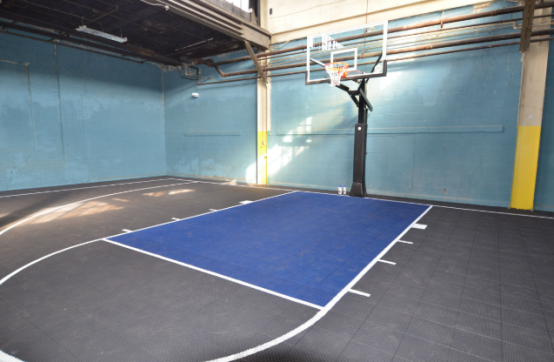
A basketball hoop is the core facility of a basketball court. It consists of a rebound, basket, and stand. The backboard should be a flat rectangle with dimensions of 1.80 meters wide, 1.05 meters high, and a bottom edge 2.90 meters above the ground. The basket is a metal ring with an inner diameter of 0.45 meters, fixed on the backboard, and the top of the basket should be horizontal, 3.05 meters above the floor. In addition, boundary markers are usually set up around the venue to clarify the scope of the competition area.
Football field
Venue specifications
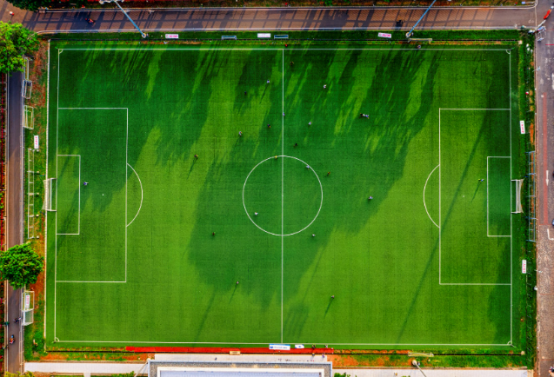
The football field is also rectangular, but relatively large in scale. The standard length of international competition venues shall not exceed 110 meters or be less than 100 meters, and the width shall not exceed 75 meters or be less than 64 meters. The length of the World Cup final stage venue is 105 meters and the width is 68 meters. The two longer boundary lines of the field are called sideline lines, and the two shorter lines are called goal lines. Draw two lines perpendicular to the goal line from 5.50 meters inside each goalpost, extending 5.50 meters into the playing field and connecting with a line parallel to the goal line. The area composed of these lines and the goal line is the goal area. Draw two lines perpendicular to the goal line from 16.50 meters inside each goalpost, extending 16.50 meters into the playing field and connected to a line parallel to the goal line. The area formed by these lines and the goal line is the penalty area. Drawing an arc outside the penalty area with a radius of 9.15 meters from each penalty point is called a penalty arc.
Facilities
The most important facility on a football field is the goal. The goal is located in the center of two goal lines, consisting of two vertical pillars 7.32 meters apart and a horizontal crossbeam with a lower edge 2.44 meters above the ground. The depth of the goal, extending from the inner edge of the goalpost and crossbeam towards the field, shall not be less than 70 centimeters and shall not exceed 120 centimeters. In addition, a center circle will be set up within the venue, with the center of the field as the center and a radius of 9.15 meters drawn.
Tennis court
Venue specifications
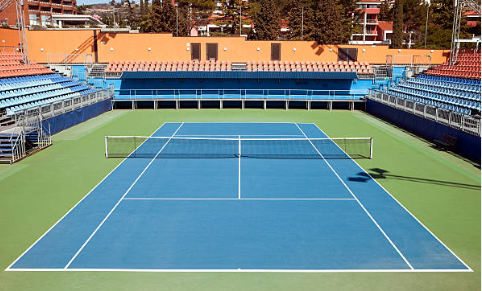
The tennis court is rectangular, with a singles court length of 23.77 meters and a width of 8.23 meters; The doubles court is 23.77 meters long and 10.97 meters wide. The boundary lines at both ends of the venue are called end lines, and the boundary lines on both sides are called edge lines. Draw a horizontal line parallel to the net on both sides of the court at 6.40 meters, which is called the serving line. Draw a line parallel to the sideline at the midpoint of the two serving lines, which is called the centerline and divides the field into two halves, left and right.
Facilities
The key facility of a tennis court is the tennis net. The length of the net is 12.80 meters, with the top of the net center at a height of 0.914 meters from the ground and both ends at a height of 1.07 meters. The ball net is supported by net ropes and net posts, and the diameter of the net posts shall not exceed 15 centimeters. The center of the net posts shall be 0.914 meters away from the outer edge of the sideline. There will also be serve area markings set up on the field to clearly define the effective range of players’ serve.
Badminton field
Venue specifications
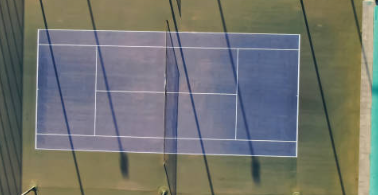
The badminton court is rectangular, 13.40 meters long, 5.18 meters wide for singles, and 6.10 meters wide for doubles. The lines around the venue are called edge lines, and the lines at both ends are called end lines. Starting from the ground of the court, the net post is 1.55 meters high and must be firmly perpendicular to the ground, keeping the net tightly pulled. At a distance of 0.76 meters from the end line, draw a horizontal line parallel to the end line, which is called the front serving line. In the doubles court, the area formed by two parallel lines from the end line to 0.76 meters inside the court, connected to the two sideline lines, is the doubles serve line.
Facilities
The core facility of a badminton court is a tennis net. The ball net is 6.10 meters long and 0.76 meters wide. The upper edge of the net is folded in half from a 75mm wide white cloth and passed through the interlayer with ropes or steel wires. The upper edge of the net must be tightly attached to the ropes or steel wires. Tighten the net with ropes or steel wires and fix it on the net post. The center of the net is 1.524 meters above the ground, and the height of the net posts at both ends is 1.55 meters.
The specifications and facilities of different ball sports venues have their own characteristics, which are closely related to the characteristics and competition rules of ball sports, and together constitute a rich and colorful world of ball sports. Whether participating in sports or watching games, understanding these differences can help us better appreciate the unique charm of ball sports.
https://www.ahbitt.com/the-comprehensive-evolution-of-ball-sports-origins-diverse-venues-and-modern-facilities/